An Eid Mubarak Reflection on Faith, Purpose, and the Meaning of Submission
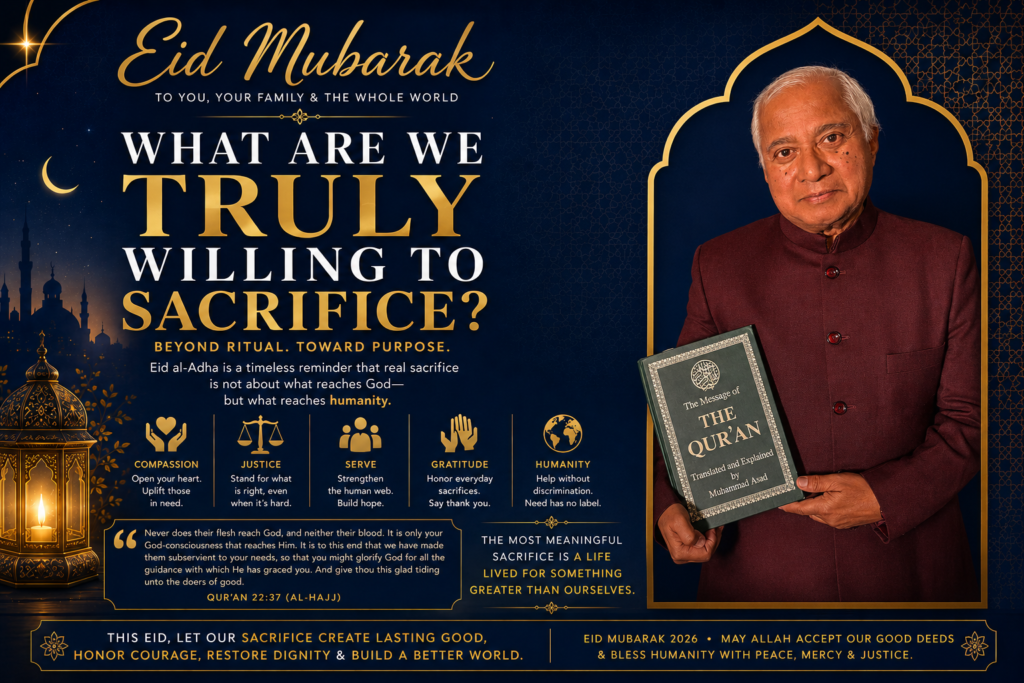
Eid Mubarak to Muslims across America and around the world as families, communities, and pilgrims gather to mark Eid al-Adha 2026 — a day rooted not merely in ritual, but in one of humanity’s deepest questions:
What are we truly willing to sacrifice for what we claim to love?
A thousand years ago, a person’s wealth lived in livestock, land, and caravans. To give away one’s prized possessions was no small act — it was a profound declaration of devotion, gratitude, and responsibility.
Today, our most guarded possession is often not livestock — it is money, comfort, convenience, time, influence, attention, and personal security. We live in an age where many will surrender sleep, relationships, health, or peace of mind — but fiercely protect their financial and emotional comfort.
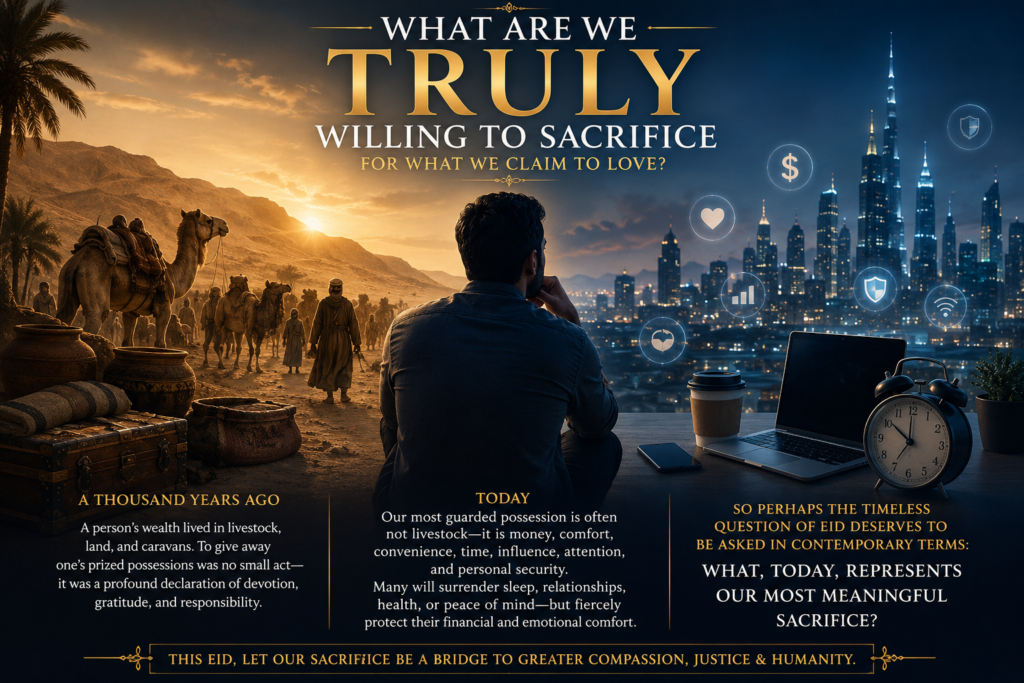
So perhaps the timeless question of Eid deserves to be asked in contemporary terms:
What, today, represents our most meaningful sacrifice?
Sacrifice Is More Than Ceremony — It Is a Test of Priorities
Sacrifice has never been about spectacle.
Sacrifice is parents quietly skipping meals so their children can eat.
It is caregivers carrying burdens no one applauds.
It is standing for truth when silence would be safer.
It is choosing integrity when dishonesty is profitable.
It is sacrificing ego to preserve relationships, sacrificing comfort to protect justice, sacrificing privilege to uplift those left behind.
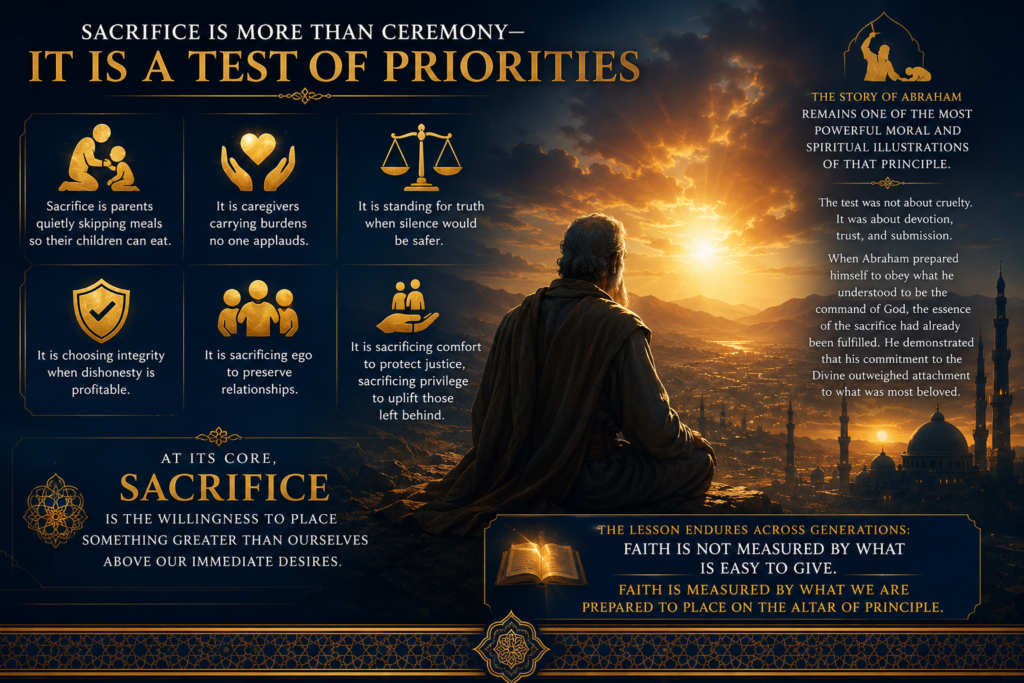
At its core, sacrifice is the willingness to place something greater than ourselves above our immediate desires.
The story of Abraham remains one of the most powerful moral and spiritual illustrations of that principle.
The test was not about cruelty. It was about devotion, trust, and submission.
When Abraham prepared himself to obey what he understood to be the command of God, the essence of the sacrifice had already been fulfilled. He demonstrated that his commitment to the Divine outweighed attachment to what was most beloved.
The lesson endures across generations:
Faith is not measured by what is easy to give. Faith is measured by what we are prepared to place on the altar of principle.
What Does Submission to God Actually Mean?
Submission to God is often misunderstood.
It is not passive surrender. It is not blind performance.
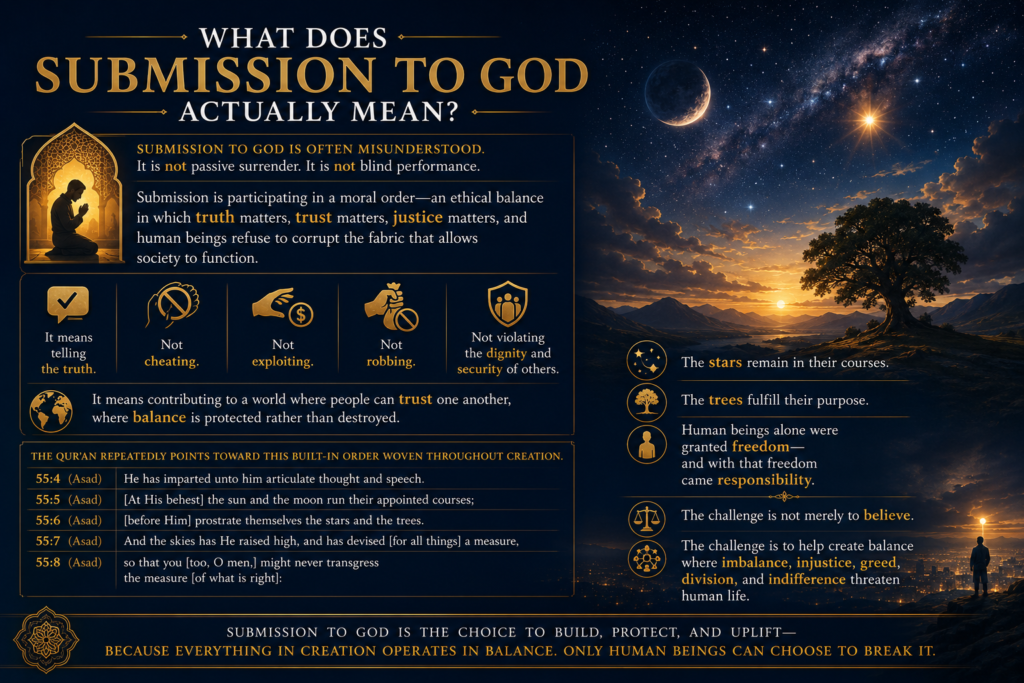
Submission is participating in a moral order — an ethical balance in which truth matters, trust matters, justice matters, and human beings refuse to corrupt the fabric that allows society to function.
It means telling the truth.
Not cheating.
Not exploiting.
Not robbing.
Not violating the dignity and security of others.
It means contributing to a world where people can trust one another, where balance is protected rather than destroyed.
The Qur’an repeatedly points toward this built-in order woven throughout creation.
55:4 (Asad) He has imparted unto him articulate thought and speech.
55:5 (Asad) [At His behest] the sun and the moon run their appointed courses;
55:6 (Asad) [before Him] prostrate themselves the stars and the trees.
55:7 (Asad) And the skies has He raised high, and has devised [for all things] a measure,
55:8 (Asad) so that you [too, O men,] might never transgress the measure [of what is right]:
The stars remain in their courses. The trees fulfill their purpose.
Human beings alone were granted freedom — and with that freedom came responsibility.
The challenge is not merely to believe.
The challenge is to help create balance where imbalance, injustice, greed, division, and indifference threaten human life.
Does God Desire Blood — or God-Consciousness?
This question deserves thoughtful reflection.
The Qur’an speaks with remarkable clarity in Al-Hajj 22:37:
“Never does their flesh reach God, and neither their blood. It is only your God-consciousness that reaches Him. It is to this end that we have made them subservient to your needs, so that you might glorify God for all the guidance with which He has graced you. And give thou this glad tiding unto the doers of good.”
The message is unmistakable.
The ultimate objective is not material transfer to God.
It is God-consciousness. Intention. Compassion. Responsibility. Moral awareness.
The outward act symbolizes an inward truth: our willingness to give from what we value in order to strengthen the human web and care for those in need.
All blessings come from God.
The question is what we choose to do with those blessings.
What Should We Sacrifice in 2026?
Millions around the world will observe traditions associated with Eid al-Adha.
Yet sincere reflection also asks difficult but necessary questions:
How do we maximize compassion?
How do we minimize waste?
How do we transform sacrifice into sustainable good?
How do we help people not only survive today — but stand stronger tomorrow?
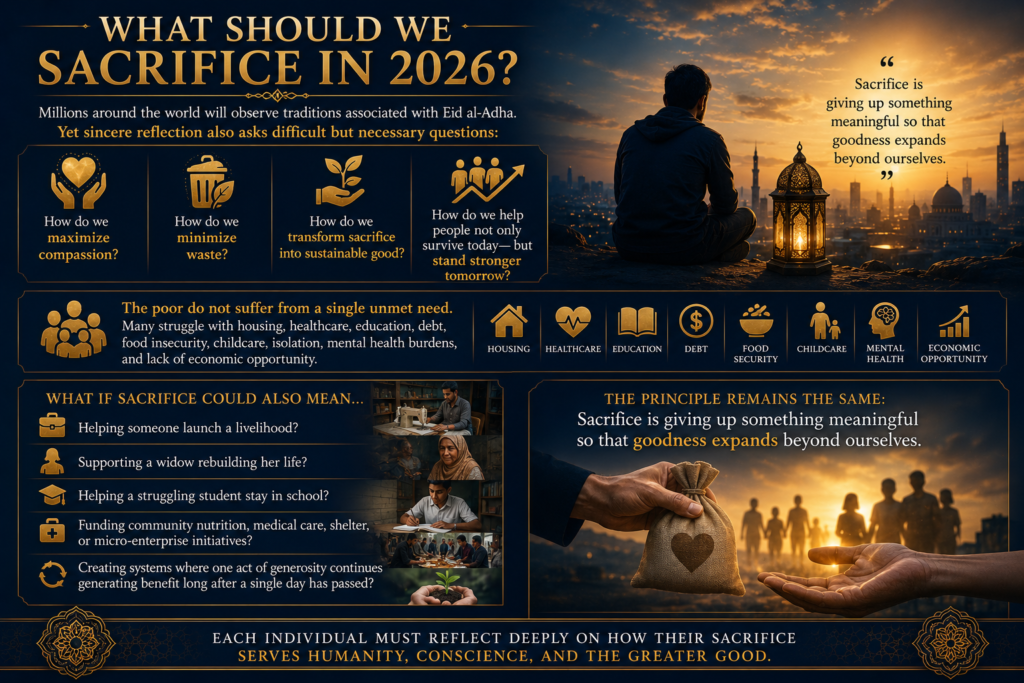
The poor do not suffer from a single unmet need.
Many struggle with housing, healthcare, education, debt, food insecurity, childcare, isolation, mental health burdens, and lack of economic opportunity.
What if sacrifice could also mean helping someone launch a livelihood?
Supporting a widow rebuilding her life?
Helping a struggling student stay in school?
Funding community nutrition, medical care, shelter, or micro-enterprise initiatives?
Creating systems where one act of generosity continues generating benefit long after a single day has passed?
The principle remains the same:
Sacrifice is giving up something meaningful so that goodness expands beyond ourselves.
Each individual must reflect deeply on how their sacrifice serves humanity, conscience, and the greater good.
Compassion Must Never Be Tribal
One of the moral failures of our age is selective compassion.
The Qur’anic ethic pushes us beyond that.
Need does not ask for a passport, denomination, ethnicity, or political identity before it becomes real.
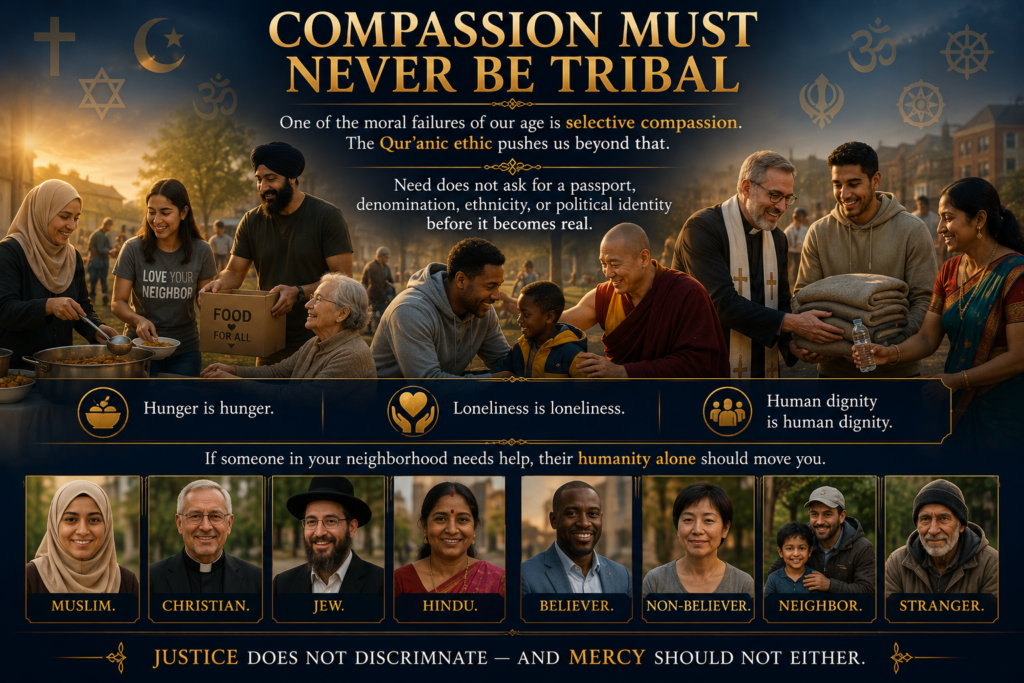
Hunger is hunger.
Loneliness is loneliness.
Human dignity is human dignity.
If someone in your neighborhood needs help, their humanity alone should move you.
Muslim.
Christian.
Jew.
Hindu.
Believer.
Non-believer.
Neighbor.
Stranger.
Justice does not discriminate — and mercy should not either.
Honoring Everyday Sacrifice
Sacrifice is not confined to sacred history.
We witness it daily.
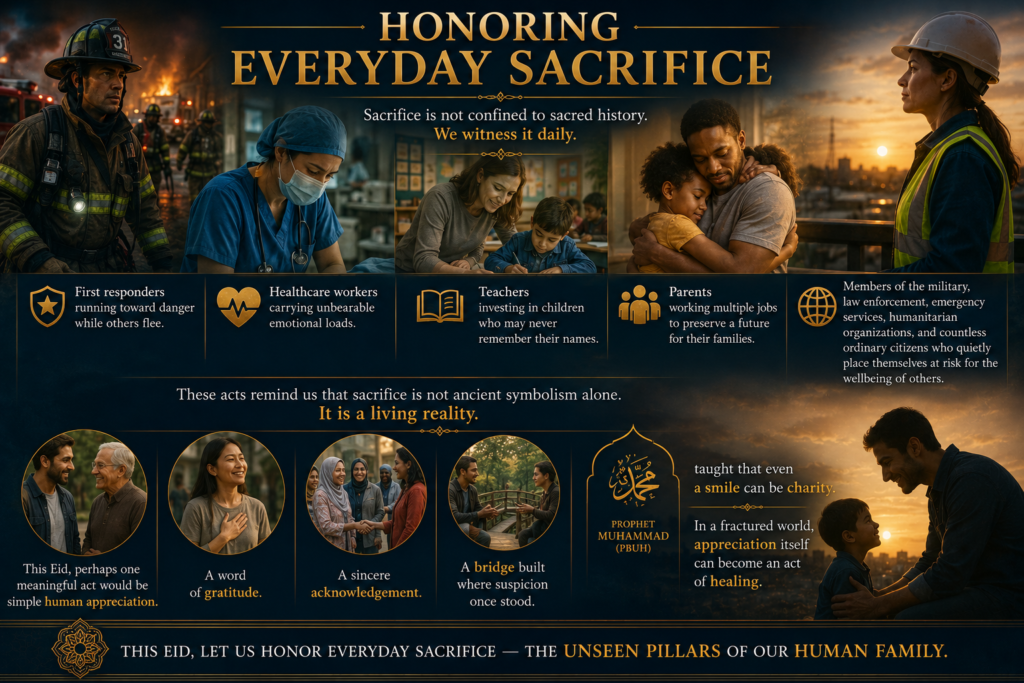
First responders running toward danger while others flee.
Healthcare workers carrying unbearable emotional loads.
Teachers investing in children who may never remember their names.
Parents working multiple jobs to preserve a future for their families.
Members of the military, law enforcement, emergency services, humanitarian organizations, and countless ordinary citizens who quietly place themselves at risk for the wellbeing of others.
These acts remind us that sacrifice is not ancient symbolism alone.
It is a living reality.
This Eid, perhaps one meaningful act would be simple human appreciation.
A word of gratitude.
A sincere acknowledgement.
A bridge built where suspicion once stood.
Prophet Muhammad (PBUH) taught that even a smile can be charity.
In a fractured world, appreciation itself can become an act of healing.
The Real Question of Eid
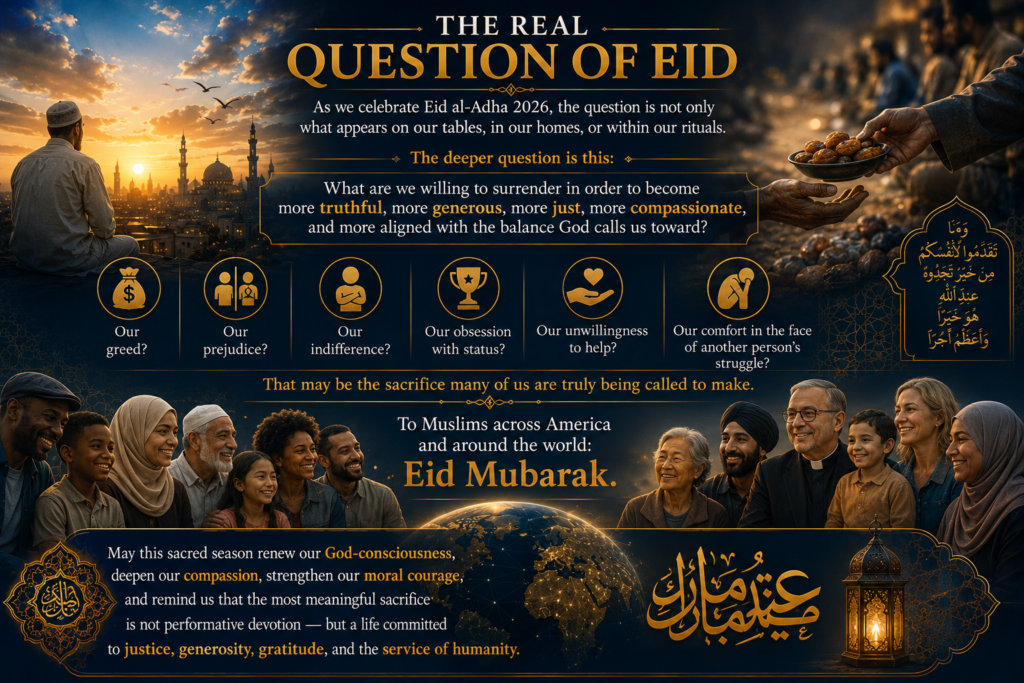
As we celebrate Eid al-Adha 2026, the question is not only what appears on our tables, in our homes, or within our rituals.
The deeper question is this:
What are we willing to surrender in order to become more truthful, more generous, more just, more compassionate, and more aligned with the balance God calls us toward?
Our greed?
Our prejudice?
Our indifference?
Our obsession with status?
Our unwillingness to help?
Our comfort in the face of another person’s struggle?
That may be the sacrifice many of us are truly being called to make.
To Muslims across America and around the world: Eid Mubarak.
May this sacred season renew our God-consciousness, deepen our compassion, strengthen our moral courage, and remind us that the most meaningful sacrifice is not performative devotion — but a life committed to justice, generosity, gratitude, and the service of humanity.
About the Author
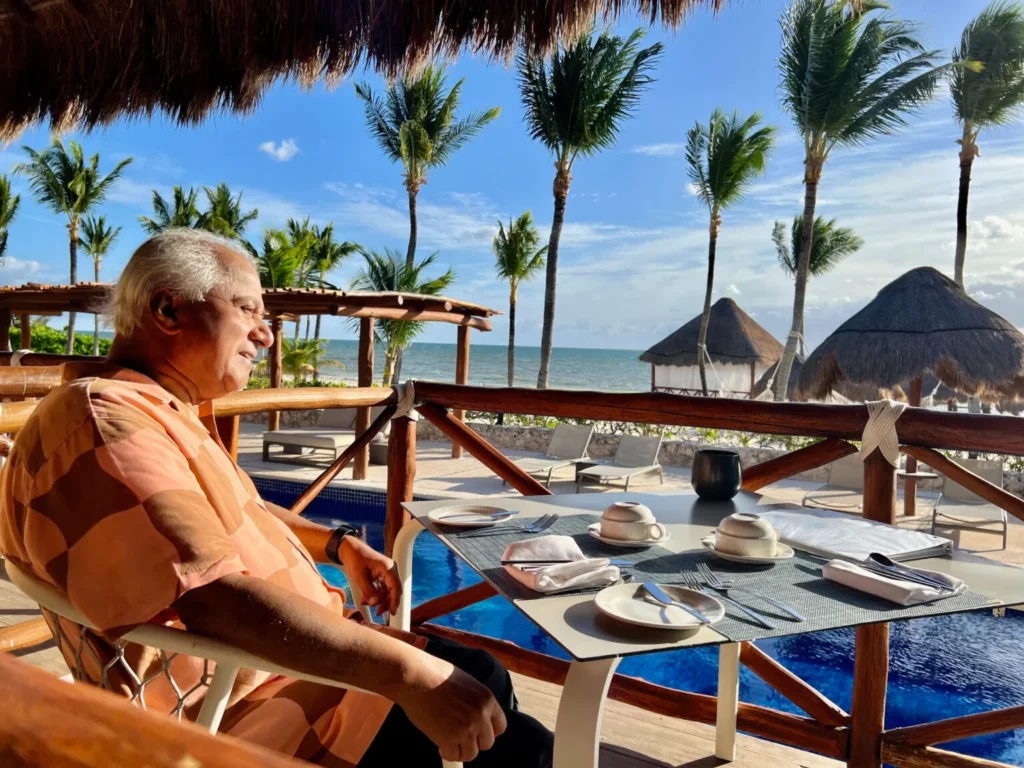
Dr. Mike Mohamed Ghouse is a Muslim author, speaker, pluralist, and social scientist whose work centers on Islam, pluralism, interfaith relations, and building cohesive societies. He is the President and Founder of the Center for Pluralism and Director of the World Muslim Congress, advancing pluralistic values embedded within Islam and offering thoughtful, practical responses to the issues of our time.
Known internationally for his bridge-building work, Dr. Ghouse has officiated 624+ marriages across 99 ethnicities and 77 cities throughout America, Canada, Mexico, Europe, and worldwide virtual settings — one of the most diverse officiant experiences in the field. Through Interfaith Marriages, Muslim Nikah, Nikah Plus, multicultural, destination, and virtual ceremonies, he has helped couples navigate faith, identity, family traditions, and cultural differences with compassion, dignity, and mutual respect.
A Muslim, activist, thinker, writer, and advocate for human understanding, Dr. Ghouse’s mission is simple yet urgent: to nurture societies where diversity is respected, differences are bridged, and the dignity of every human being is honored.
Learn more: www.WorldMuslimCongress.com