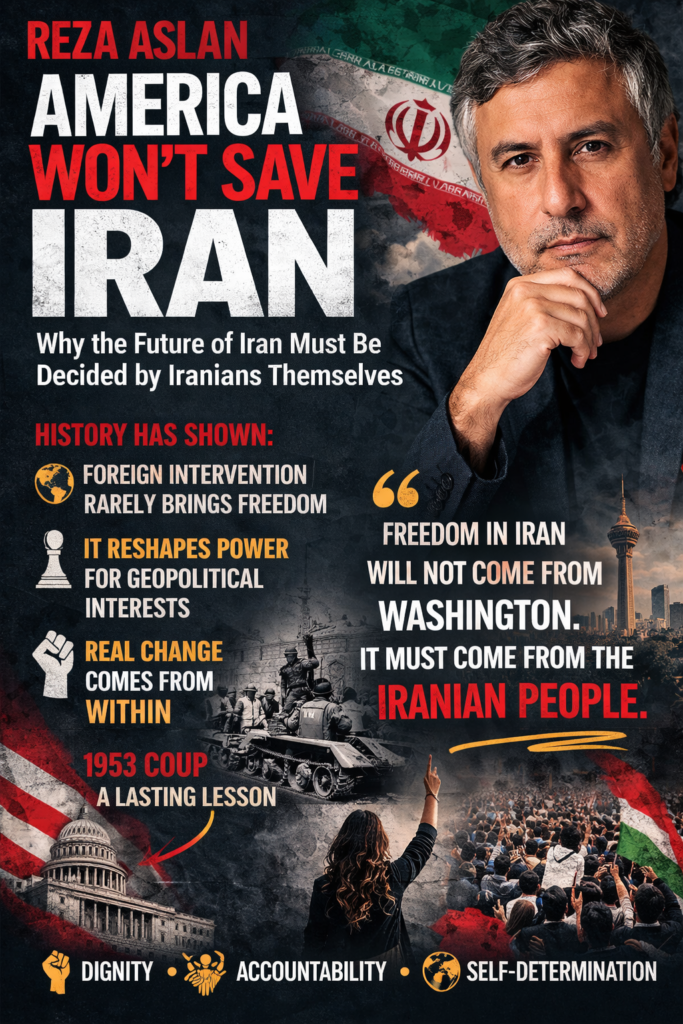
Aslan is a writer and scholar of religions living in Los Angeles.
The following paragraphs from the article are the expression of the people of Iran. Reza is this millennium’s intellectual. In the following article, he has given the most comprehensive analysis of the people of Iram.
Much of that work has centered on a simple argument: that the best way to support Iranians struggling against authoritarian rule is not through isolation or military confrontation but through engagement, diplomacy, cultural exchange and economic ties that open the country to the world, giving the United States both leverage and responsibility in shaping the regime’s behavior.
Any people, however bitterly they may resent their rulers, can rally when the nation itself appears under attack. When foreign bombs fall on cities, when homes are destroyed and children are killed, the line between opposition to a government and defense of a homeland can collapse.
It is for this reason that many analysts believe the most likely outcome of the American-Israeli bombing campaign is not the advent of liberal democracy but rather a shift in the regime’s center of gravity — from clerical dominance to military dominance. The robes recede, the uniforms step forward, and one tyranny replaces another.
None of these paths are guaranteed. All carry risk. Nevertheless, durable change, if it comes, will most likely emerge from the slow accumulation of pressure inside the country, not from the sudden imposition of force from outside.
When I saw the images of bombs falling on Tehran — smoke rising over neighborhoods I once knew — and heard the familiar talk of liberation and an opportunity for Iranians to reclaim their country, I felt a recognition that was almost immediate.
I have lived inside this story for most of my life, first as a child in Iran, then as an immigrant to the United States, and later as someone trying to explain my country to Americans who often encounter it only in moments of crisis.
I have seen before how things unfold when an American president is cast as Iran’s savior. The year was 1977. I was five years old and standing on the side of a Tehran street when President Jimmy Carter’s motorcade drove past.
The revolution had not yet erupted, but it was already rumbling beneath the surface. To the outside world, the shah’s regime projected strength and modernity: highways, oil wealth, grand celebrations of imperial history. But behind the spectacle lay prisons, censorship and the quiet terror of the secret police. Political parties had been hollowed out, dissent punished.
Even as a child, I could feel the tension in the air. I do not recall the slogans or the speeches that day. What I remember is the adults around me leaning forward, whispering that this American president was different. He would hold the shah accountable. He would protect the Iranian people.
Back then, I carried an image of America as something almost mythic. It was not just a distant superpower. It was a moral force, a place that corrected wrongs, defended the vulnerable, tipped history toward justice. In my childhood logic, America was the grown-up who suddenly appeared on the playground to put the class bully in his place.
That was the hope in the air — that the visiting American president might act not merely as a guest of the regime but as a check upon it. That he might be, in some quiet way, a liberator. Instead, Carter toasted the shah’s rule and called Iran “an island of stability.”
Something shifted that day, not only in the politics of the country but in the psyche of the Iranian people. The belief that American power might rescue us dissolved into something harder and more sober: the realization that American interests and the aspirations of the Iranian people simply did not align.
Two years later came the revolution. Then the storming of the U.S. Embassy. Then the 444 days of the hostage crisis that would brand Iran in the American imagination for decades. Nearly half a century of mutual suspicion followed — two nations using each other as mirrors, each reflecting back a distorted image against which it could define its own virtue: one cast as the “Great Satan,” the other flattened into a caricature of religious fanaticism.
And now, once again, the old fantasy of America as savior is returning.
In recent days, American and Israeli strikes have largely targeted sites associated with Iran’s military infrastructure. The official justification is elastic — deterrence, security, stabilization — terms broad enough to stretch around almost any action. The rhetoric around the campaign, however, is as clear as can be.
Hours after the first bombs fell on Tehran, President Trump addressed the Iranian people directly, urging them to “take over your government” after having promised that “help is on its way.” This was the language not of deterrence but of deliverance — an American president stepping in as Iran’s liberator.
Unlike in 1977, however, the loudest voices advancing this narrative are not in Tehran but in Los Angeles. The city where I live is home to the largest Iranian population outside Iran. On any given afternoon you can walk past Persian bookstores and jewelry shops, bakeries perfumed with cardamom and rosewater, satellite television studios broadcasting Persian-language news and entertainment. Exile here is layered: it lives in accents softened but not erased, in older parents who will never return home, in children who speak Persian imperfectly but carry inherited grief fluently.
I, too, carry that same inheritance. My family fled Iran in 1979 with little warning. We arrived in America with almost nothing. In the years that followed, we built new lives while navigating the suspicion and slurs that only intensified after the hostage crisis.
Back in Iran, clerical rule consolidated itself through fear and war. A generation was sent to the front lines in the brutal conflict with Iraq, boys barely out of childhood marching into battle. Prisons filled with political dissidents. Executions were carried out in the quiet of night. Women’s bodies became sites of state enforcement, policed in the street, disciplined in classrooms, punished for defiance. Students who gathered to protest were beaten or disappeared. Journalists learned that a single sentence could cost them their freedom.
Inside Iran, those decades forged endurance and a hard-earned familiarity with risk, patience and survival. Young people hosting underground parties in borrowed apartments, curtains drawn tight, music kept just low enough to avoid a knock at the door. Couples circling city blocks in slow-moving cars, stealing moments of conversation before morality patrols intervene. Women pushing their head scarves back a few inches further each year — an act so small it can seem trivial from afar, and so dangerous it can invite arrest, beatings or worse.
Outside Iran, those same decades led to something more volatile. In Los Angeles and other diaspora communities, anger at the regime runs deep, but so does an awareness of how easily that anger is folded into media narratives that blur criticism of clerical rule with suspicion of Islam itself. Iranian Americans have learned to condemn repression while bracing against the racism and reductive thinking that often follow. They carry two anxieties at once: the suffocation of the homeland and the caricatures of it abroad.
That tension has understandably bred impatience. Years of watching protests crushed and reforms reversed have made incremental change feel illusory. It is little wonder, then, that many have come to believe that only something dramatic — some outside force — could finally break the cycle of repression.
So when bombs fall on facilities linked to the regime, some in exile do not see escalation. They see possibility. They gather in celebration. There are flags, speeches, applause. Civilian casualties are described as tragic but unavoidable. The logic becomes arithmetic: whatever hastens the regime’s end is worth the cost.
But the cost isn’t theoretical; it has a face. Among the recent reports comes word that strikes have hit civilian sites, including a girls’ school. Children who have nothing to do with uranium enrichment or missile silos are being pulled from the rubble. Their deaths are disputed in numbers and spun in statements, but the moral fact remains: when you invite bombs as salvation, you are also inviting the deaths of innocents.
I understand the grief that drives many of my fellow Iranian Americans to this point. I, too, lost my country. I, too, have family still living under an intolerable regime. When you feel powerless to alter events from within, force from without can feel like the only remaining lever.
But Iranians have a long memory of foreign intervention, and it does not map neatly onto liberation. I was reminded of this during the women-led uprising in Iran in 2022. After the death of Mahsa Amini in the custody of the morality police, protests spread across the country under the rallying cry Woman, Life, Freedom. Women removed their head scarves in public. Students walked out of classrooms. Workers joined strikes. Teenagers filmed themselves confronting security forces in the streets. As usual, the response from the regime was swift and brutal — arrests, beatings, executions carried out after secret trials.
For Iranians abroad, the uprising stirred a volatile mix of pride, grief and helplessness. Diaspora communities filled the streets of Los Angeles, Berlin, Toronto and London in solidarity, watching events unfold in real time on their phones. The protests rekindled a powerful hope that change might finally come from within. But they also sharpened a familiar conundrum: how to support a movement for freedom without feeding the narrative, eagerly embraced by the regime, that such movements are merely instruments of foreign meddling.
At the time, I was on a book tour for a biography of an American who died fighting for Iranian democracy more than a century ago. The tour felt, in many ways, like the culmination of two decades I had spent writing and speaking about Iran from exile, trying to explain its history, culture and politics to American audiences. Much of that work has centered on a simple argument: that the best way to support Iranians struggling against authoritarian rule is not through isolation or military confrontation but through engagement, diplomacy, cultural exchange and economic ties that open the country to the world, giving the United States both leverage and responsibility in shaping the regime’s behavior.
Those views have never been universally welcome in exile communities. As a progressive voice arguing in favor of diplomacy, I have often been accused of naïveté or worse. When the women’s protests intensified and the regime’s repression filled our screens, several of my events were disrupted by well-meaning but inflamed activists, many of them apparently swept up in deliberate misinformation campaigns, who insisted that anything short of my full-throated support for regime change — by force, if necessary — amounted to complicity with the regime itself.
Courtesy New York Times : https://www.nytimes.com/2026/03/06/opinion/iran-bombing-america.html