Introduction: Understanding the Shia Sunni Conflict Through Reflection
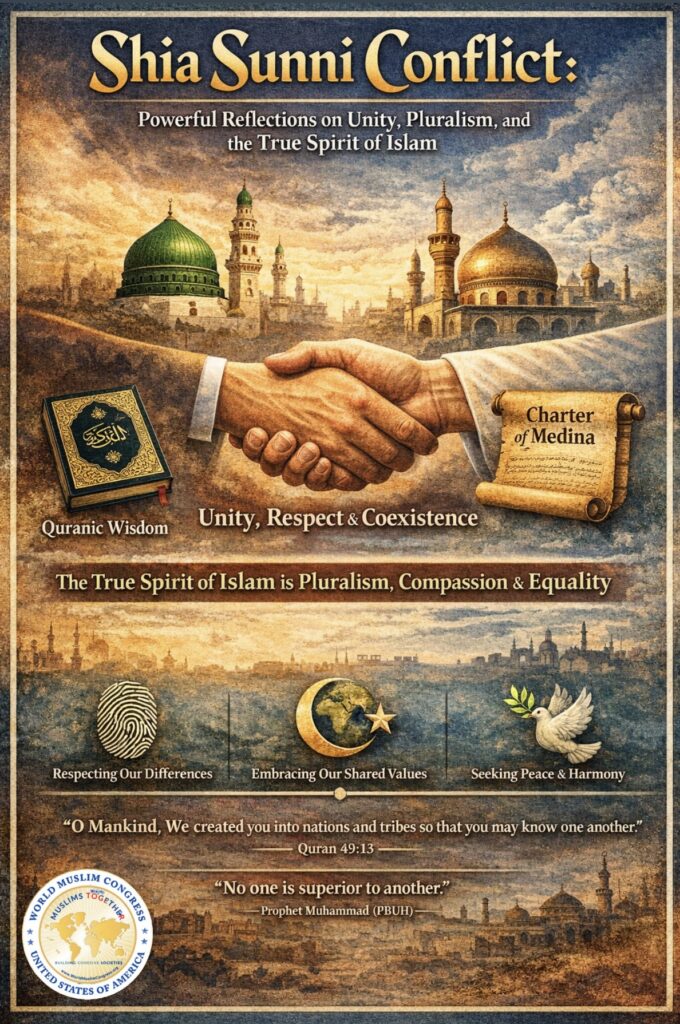
The Shia Sunni conflict is often discussed as a major division within the Muslim world. However, understanding the Shia Sunni conflict requires deeper reflection on Islamic teachings, history, and the spirit of pluralism that the Quran and Prophet Muhammad emphasized.
I had the opportunity to work with Prof. Rashid Shaz during a seminar at AMU (Aligarh Muslim University, India). He is a genuine mufakkir—a thinker who embodies the Quranic call for reflection. The Quran encourages its readers to contemplate each verse deeply: why God said what He did, what He meant, how humanity (the Naas) benefits from it, and whether a message applies specifically to Muslims or to the Aalameen (all of humanity).
Prof. Shaz addressed the Shia Sunni conflict and offered an insightful perspective rooted in Islamic teachings and historical understanding.
Prophet Muhammad’s Vision of Unity Beyond the religions
In his discussion, Prof. Shaz pointed out how Prophet Muhammad (PBUH) brought different tribes in the City State of Madina together under the banner of Ummah, a concept that transcended tribal, religious and sectarian divisions.
The Prophet’s vision of the Ummah was inclusive. It included:
- Jews
- Christians
- Quraish
- Other tribes and communities
Each group maintained its identity within the framework of the Meesaq (bond of agreement).
This historical model demonstrates that the foundations of Islam were built on unity, coexistence, and pluralism, not sectarian rivalry or the Shia Sunni conflict we often see discussed today.
Hearing Prof. Shaz articulate this perspective was truly refreshing and thought-provoking.
How Upbringing Shapes Religious Identity
If you were raised as:
- Sunni
- Shia
- Ahmadi
- Sufi
- A follower of WD Muhammad
- A member of the Nation of Islam
- Or a part of their many subgroups
then that tradition naturally becomes part of your identity and gets embedded in your pyche.
That is what you have come to believe, and most people hold on to those beliefs throughout their lives.
Expecting someone to abandon their inherited beliefs simply because others disagree is unrealistic.
A helpful analogy is food. People raised with certain foods often seek them out wherever they go. Your mother’s cooking, after all, often tastes the best.
In the same way, many individuals find comfort in the beliefs and traditions of their upbringing.
There is nothing wrong with this.
Beliefs work for individuals in different ways, and there is no need for anyone to change unless they genuinely choose to explore another path.
Respecting Diversity in Beliefs and Practices
Learning to accept and respect others’ uniqueness is essential if we want to move beyond tensions like the Shia Sunni conflict.
If God had wanted humanity to be identical, He could have created us like robots.
Instead, He created us with:
- Unique thumbprints
- Distinct eyeprints
- Individual DNA
He also placed us into:
- Different tribes
- Ethnic groups
- Nations
- Cultures
The Quran reminds us that the best among us are those who strive to understand one another.
Ultimately, God desires peace and harmony within His creation.
A Simple Question About the Shia Sunni Conflict
Ask yourself a simple question:
What do I lose if someone else prays or believes differently?
Reflect on the essence of their beliefs and practices.
If you genuinely seek freedom from the tensions created by others’ actions and religious beliefs, consider these three questions deeply.
1. What is my loss
2. What is the essence of their prayers
3. Am I responsible for their religious beliefs and practices.
You may discover something powerful: Inner freedom.
Individual Accountability on the Day of Judgment
Islam emphasizes personal accountability.
On the Day of Judgment, you will not be judged based on the deeds of others.
Not your:
- spouse
- father
- mother
- imam
Each individual is responsible for their own actions.
This principle reminds us that conflicts like the Shia Sunni conflict should not overshadow the personal spiritual responsibility every believer carries.
What the Quran Says About Salvation (Quran 2:62)
Many people are surprised when they read what the Quran says in Surah Al-Baqarah (2:62) and similar verses.
These verses suggest something profound:
You do not need to carry a Muslim religious label to earn God’s blessings.
Instead, what matters most to God is;
- Belief in a singular cause of the universe – one God or one creator
- Accountability for one’s actions – no one goes scot-free
- Care for God’s creation
These values form the ethical foundation of peaceful human coexistence.
Once again, everything God asks of humanity ultimately promotes security, compassion, and peace. It is for our good.
Take time to reflect on this.\
The Prophet’s Final Sermon and the Principle of Equality
In his final sermon, Prophet Muhammad delivered one of the most powerful messages of equality in human history.
He emphasized:
“No one is superior to another.”
He also conveyed God’s message that no prophet is greater than another.
Each prophet was sent to restore harmony within society.
Their mission was to ensure that people could live:
- securely
- peacefully
- with dignity
Equality remains the cornerstone of building cohesive and harmonious communities.
Pluralism at the Heart of Islam
I have spoken and written extensively about how pluralism lies at the heart of Islam.
This belief is grounded in both:
- Quranic verses
- The practices of Prophet Muhammad
Pluralism encourages mutual respect and cooperation between communities.
In this context, discussions about the Shia Sunni conflict should not divide us but instead inspire deeper understanding.
Prof. Shaz’s insights offer additional perspectives that reinforce the importance of pluralism in Islamic thought.
Additional Resources on the Shia Sunni Conflict and Pluralism
Dr. Shaz’s video about Shia-Sunni
https://www.facebook.com/share/p/1LB3GG8Lkh
- My speech at AMU – http://futureislam.org/dr-mike-ghouse-addressing-first-high-profile-international-conference/
- Sunni Muslim, is that who I am?
https://www.newageislam.com/islam-sectarianism/dr-mike-ghouse/sunni-muslim-that-i-am/d/106865
- Shia Sunni Takfiriyat is not acceptable.
- Who is a Muslim? On the home page, scroll down to A Muslim is a Muslim is a Muslim. https://worldmuslimcongress.org/
- You don’t need to wear the Muslim label to earn Allah’s blessings
https://interfaithmarriages.org/who-is-a-muslim-and-what-is-islam/
The Meesaq-e-Madina: The First Written Constitution
The Meesaq-e-Madina (Charter of Medina) was enacted by Prophet Muhammad (PBUH) in 622 CE after his migration to Medina.
It is widely considered the world’s first written constitution.
The charter established:
- A sovereign pluralistic city state of Medina
- Rights and responsibilities of different communities
- Mutual defense agreements
- Religious freedom
- Security for Jews, Christians, Muslims and all others
The document united Muslims, Jews, and other tribes under a pluralistic system of governance.
This historic framework promoted peace, cooperation, and coexistence, offering a powerful model for resolving tensions such as the Shia Sunni conflict. All we have to do learn to respect the otherness of the others, and accept the uniqueness of each of us.
A few urchins among Sunni traditions spread lies that the Shia community curses Hazrat Aisha, Abu Bakr Siddiq, Umar and Uthman. Sunni Muslims, particularly in extremist circles, often accuse Shia Muslims of heresy, apostasy, and distorting fundamental Islamic beliefs. Key allegations include exaggerating the status of Ali, disrespecting the Prophet’s companions, using a corrupted Quran, and practicing taqiyyah (dissimulation) to hide their true beliefs.
Shia Muslims primarily accuse Sunnis of violating the legitimate succession of Prophet Muhammad by rejecting the divine leadership of Ali ibn Abi Talib. They also accuse Sunni historical figures of undermining the Prophet’s family, and argue that Sunni jurisprudence and Hadith sources are flawed, ultimately perpetuating the marginalization of the Shia minority.
Neither of the accusations by extremists among Shia or Sunni are true. It must be rejected
Ayatollah Khameini, the spiritual Imam of the Shia tradition issued a fatwa asking the urchins among Shia to respectfully treat Hazrat Aisha and the Caliphs.
I urge both communities to respect the otherness of the other.
About Dr. Mike Ghouse
Dr. Ghouse is the President and founder of the Center for Pluralism and director of the World Muslim Congress. He is an Interfaith Wedding Officiant for InterfaithMarriages.org and a Muslim Wedding Officiant. He is a Muslim, Pluralist, activist, speaker, author, and social scientist. More on Google
Dr. Ghouse is known as a:
- Muslim pluralist
- activist
- speaker
- author
- social scientist
More information about his work can be found through Google searches and his published writings.
Frequently Asked Questions (FAQ)
1. What is the Shia Sunni conflict?
The Shia Sunni conflict refers to historical and theological differences between the two largest branches of Islam. These differences originated after the death of Prophet Muhammad regarding leadership of the Muslim community.
2. Did Prophet Muhammad support sectarian divisions?
No. Prophet Muhammad emphasized unity, equality, and cooperation among communities, as demonstrated through the Charter of Medina and his final sermon.
3. What does the Quran say about religious diversity?
The Quran acknowledges diversity among people and encourages mutual understanding, respect, and peaceful coexistence.
4. What is the Charter of Medina?
The Charter of Medina was the first written constitution that established a pluralistic society where Muslims, Jews, and other tribes lived together with shared rights and responsibilities.
5. Can Muslims with different beliefs coexist peacefully?
Yes. Islamic teachings encourage acceptance, pluralism, and respect for diverse beliefs within and beyond the Muslim community.
6. How can individuals help reduce the Shia Sunni conflict?
Individuals can promote dialogue, mutual respect, education, and understanding while focusing on shared Islamic values such as justice, compassion, and unity.
Conclusion: Moving Beyond the Shia Sunni Conflict
The Shia Sunni conflict should not define the essence of Islam.
At its core, Islam promotes:
- pluralism
- equality
- compassion
- coexistence
The teachings of the Quran, the practices of Prophet Muhammad, and historical examples like the Charter of Medina remind us that diversity is not a weakness—it is a strength.
When individuals choose reflection, understanding, and respect, communities can move beyond division and build a world rooted in peace, harmony, and shared humanity.