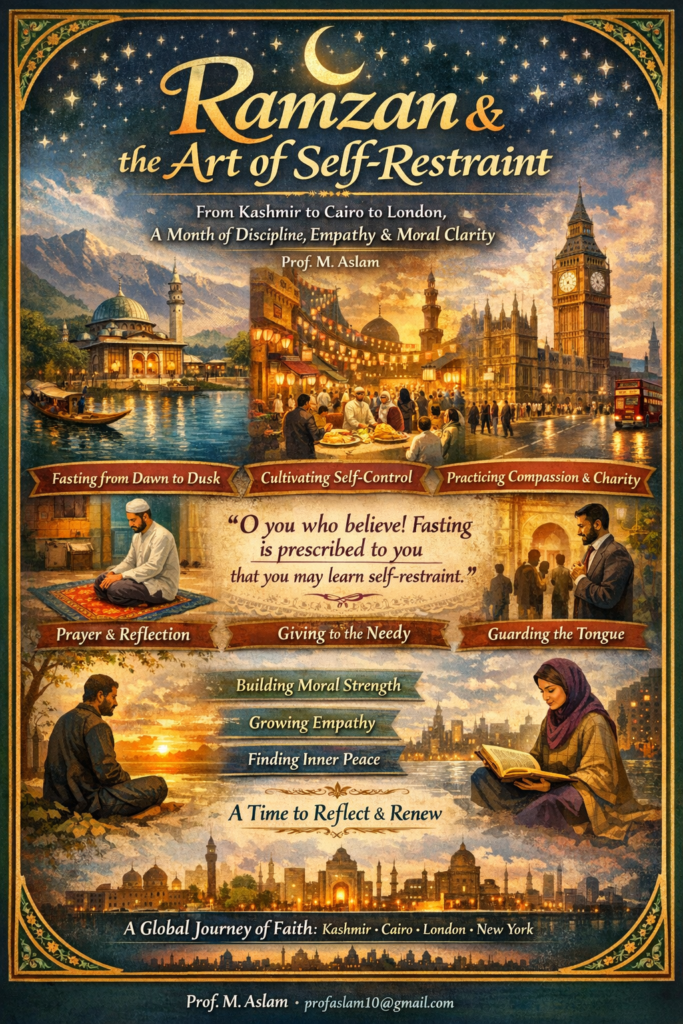
From Kashmir’s dawn prayers to packed streets in Cairo and London, Ramzan invites the world into a month of discipline, empathy, and moral clarity.
By Prof. M. Aslam
The arrival of Ramzan rearranges priorities and sharpens the moral lens through which life is viewed. A thin crescent in the sky signals the start of a month that calls human beings to examine appetite, speech, conduct, and conscience with unusual seriousness.
The Holy Qur’an frames the fast with a direct appeal: “O you who believe! Fasting is prescribed to you as it was prescribed to those before you, that you may learn self-restraint.”
The verse links today’s believers with earlier communities and places self-control at the center of worship. Fasting becomes a shared human discipline with a clear objective. The goal is restraint that refines character. Roza lasts one full lunar month each year. It requires abstinence from food and drink from dawn to sunset. But its meaning extends far beyond hunger. A genuine fast demands control over the tongue and the mind. It calls on a believer to avoid lies, fulfill work with honesty, give full measure, practice justice, and step away from harmful conduct. In simple Urdu, the teaching stands clear: “Roza ek ibadat hai aur yeh sirf bhooke pyase rehne ka naam nahin hai.”
Fasting is worship, and worship includes truthfulness, integrity, and fairness in everyday dealings. The American writer Michael Wolfe once kept a Ramzan fast out of curiosity. In his essay “Armouring the Heart,” he described how the experience taught him self-control and empathy. At first, he watched the clock and felt the pull of appetite. As the days passed, he sensed a shift. He felt empowered by his ability to master desire.
Time seemed to change character. The minutes near sunset gained meaning, while the rest of the day moved with calm focus. He wrote that Ramzan turns time on its head. His account supports what many believers feel every year.
Human beings consist of physical, emotional, biological, and spiritual dimensions. Health grows when these elements remain in balance. Ramzan trains the observer in that balance.
Hunger humbles the body and tempers excess. Prayer elevates thought and intention. Reflection steadies emotion. The month becomes a practical lesson in harmony between body and spirit.
Fasting also strengthens moral courage. It conditions the heart and guides emotion toward ethical choices. Control over appetite often leads to control over anger and impulse. The great Sufi poet Jalaluddin Rumi expressed this truth in a simple line: “Have patience, for that is true worship.” Ramzan turns that insight into daily practice.
Long hours without food and drink build endurance, that endurance develops discipline, and that discipline strengthens integrity.At its core, Ramzan operates as a sustained process of self-purification.
A full month of conscious restraint aims to refine habits and elevate behaviour. The expectation carries depth. If a person commits to this discipline for thirty days, its imprint should guide the remaining eleven months. The fast becomes an annual reset for conscience and conduct.
Modern observance sometimes drifts toward display. Iftar gatherings can revolve around social status or political visibility. Decorative lights and elaborate menus may command attention. These elements create festivity, though they can also shift focus away from introspection and service. The spirit of Ramzan centers on prayer, charity, and ethical reform. Its essence calls for humility and thoughtful action.
Viewed through a sociological lens, fasting expresses solidarity with the poor. Hunger during the day offers a direct encounter with deprivation. Charity, neighbourhood care, and hospitality form the social backbone of this month. Giving expands, and concern for the less fortunate gains significance in daily conversation. A fasting person experiences hunger and develops empathy for those who face it throughout the year. That shared experience strengthens social bonds and deepens moral awareness.
Ramzan also intensifies ordinary duties. Believers perform daily responsibilities with greater care, increase prayer, and extend charity, all while abstaining from food and drink.
This layered effort strengthens self-discipline. A chain smoker discovers that a habit can halt. A constant snacker realizes that impulse can yield to will. A person tied to hourly coffee learns that desire responds to intention. The fast demonstrates that mastery over self stands within reach. Human impulse often rises from immediate appetite. Ramzan teaches that appetite answers to conscience. The fast sobers the mind and renews spiritual focus. It sharpens awareness of right and wrong.
One of its strongest outcomes lies in truthful speech. The Prophet Muhammad (peace be upon him) advised believers to speak what is true, even when it feels bitter. Truthfulness, hospitality, care for neighbours, and charity together define the moral profile of a genuine fast. Such conduct aligns the individual with divine grace and protection.
Ramzan speaks to a global audience. In homes in Kashmir, in markets in Istanbul, in neighborhoods in Lagos, and in apartments in New York, the daily fast resets routine and creates a shared sense of purpose. It changes the pace of life and invites deeper reflection. It teaches that self-restraint builds inner strength. It reveals that empathy grows through lived experience. It makes clear that faith finds its true expression in honesty and justice.This month provides a disciplined path toward moral clarity. It trains the heart, balances the mind, and elevates the spirit. When embraced in its full meaning, Ramzan becomes a powerful annual exercise in becoming better human beings.
— The author is a social scientist and former Vice-Chancellor of the Indira Gandhi National Open University in New Delhi. He can be reached at : profaslam10@gmail.com