I have been asked many times whether Ghamidi Sahib is an Alim, and my answer has always been consistent. Every time someone asks me, I respond the same way: Prophet Muhammad (peace be upon him) authorized me to learn and speak for Islam, when he said, “I am leaving this book to you.” He did not say, “I am assigning this book to Abu Bakr, Umar, Usman, or Ali,” nor did he instruct, “You need to go to Al-Azhar.” My learning involves deep studying 25 translations of the Quran and questioning each verse to understand why God has conveyed those messages and what is the impact on society.
This is exactly the path that makes someone an Alim in the truest sense. Knowledge is not merely about attending a school, earning certificates, or memorizing texts—it is about understanding, questioning, and reflecting on the Quran’s guidance.
Understanding Who an Alim Is
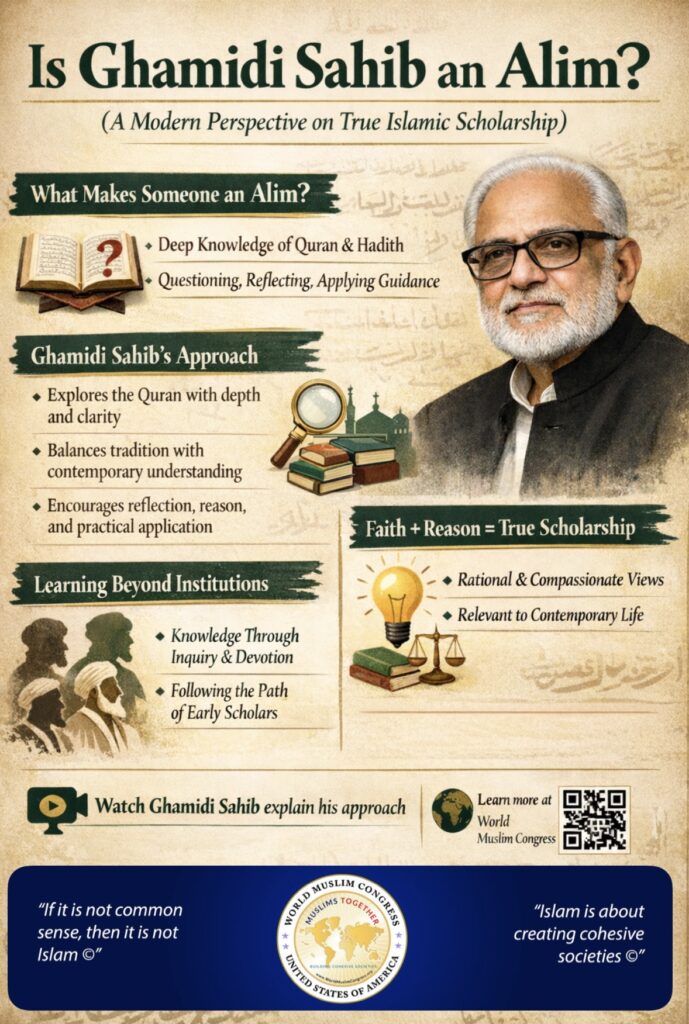
An Alim is someone who has deep knowledge of Islam, particularly the Quran and Hadith, and who can guide others to live in accordance with divine principles. But this knowledge is not measured by formal schooling alone. History provides countless examples of true scholars who became Alims without attending traditional institutions.
Take Hazrat Abu Bakr Siddique, Umar, Usman, and Ali, for example. They did not study at any formal school; they learned directly from the Prophet and the Quran. Similarly, the great imams—Hanafi, Shafi’i, Bukhari, and Maliki—became authorities in Islamic scholarship through personal study, reflection, and devotion. True knowledge is cultivated through inquiry, reflection, and sincerity, not by a classroom or diploma.
Why Ghamidi Sahib Qualifies as an Alim
Ghamidi Sahib is an Alim because he exemplifies what Islamic scholarship truly entails. He does not blindly follow tradition; instead, he studies the Quran deeply, analyzes its verses, and interprets them in a way that makes sense to contemporary Muslims. His method demonstrates that faith and reason can coexist, and that understanding Islam requires thinking critically rather than accepting ideas without reflection.
Islam aims to create harmonious societies where people live peacefully and respectfully. Allah desires a world in which all its elements coexist in balance and unity. When religious teachings contradict common sense, they deviate from the essence of Islam. Ghamidi Sahib understands this principle deeply. He emphasizes rationality, logic, and compassion in interpreting Islam, which is why I consider him a true Alim.
Learning Beyond Institutions
Many ask me whether formal education is necessary to become a scholar. My answer is simple: it is not. Ghamidi Sahib’s approach mirrors the way the companions of the Prophet and classical scholars pursued knowledge. They sought understanding, asked questions, and applied divine guidance to their lives and society. Similarly, Ghamidi Sahib studies multiple Quran translations, reflects on their meanings, and extracts lessons that are both spiritually and socially relevant.
This is the hallmark of an Alim: not titles, degrees, or recognition, but dedication, critical thinking, and a sincere desire to guide others.
Bridging Tradition and Modernity
In today’s world, many Muslims struggle with rigid interpretations of Islam that create division and confusion. Scholars like Ghamidi Sahib serve as bridges between tradition and modernity. His work shows that the Quran’s message is timeless, but its understanding requires reason and context. By questioning, reflecting, and teaching thoughtfully, he ensures that the principles of Islam are accessible, rational, and practical for contemporary life.
Watch Ghamidi Sahib’s Explanation
For those who wish to hear Ghamidi Sahib explain his approach personally, I recommend this video. It captures his method of learning and teaching and provides insight into why he is widely regarded as an Alim today.
Conclusion
In my view, Ghamidi Sahib is unquestionably an Alim. His scholarship is rooted in deep understanding, rational interpretation, and adherence to the Quran. He demonstrates that being an Alim is about questioning, reflecting, and guiding others with wisdom, not merely attending a school or memorizing texts.
For anyone seeking to understand Islam in a meaningful way, Ghamidi Sahib offers a path that combines faith, intellect, and practical wisdom. His example shows that true scholarship is accessible to anyone who approaches the Quran with sincerity and reflection.
For more insights on contemporary Islamic scholarship, visit the World Muslim Congress.