By Dr. Mike Ghouse
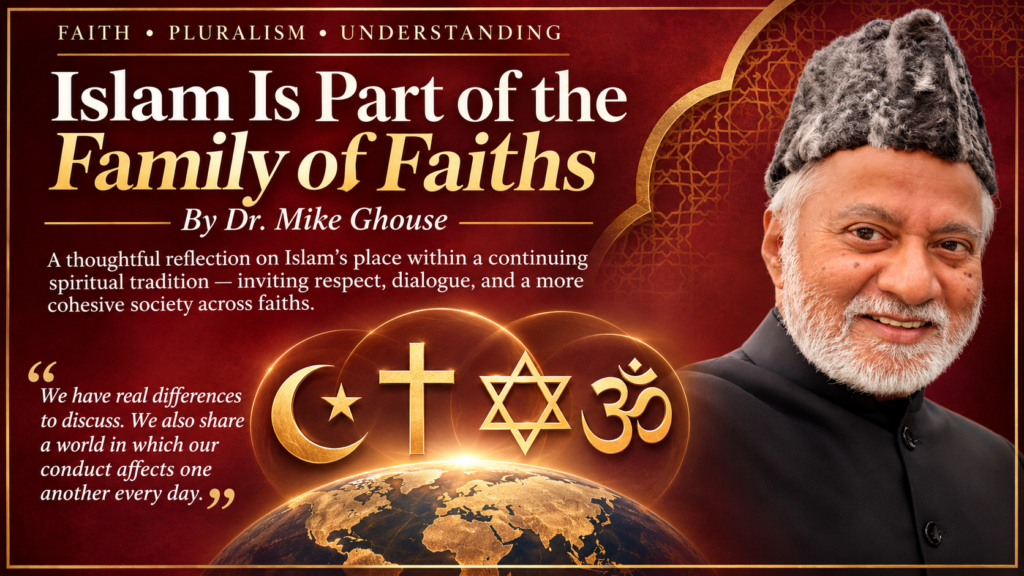
When I describe Islam as part of the family of faiths, I am inviting us to recognize that wider horizon. We can take our convictions seriously while learning about another person’s beliefs and working together for a society in which everyone feels secure.
A different name for God, an unfamiliar prayer, an image we do not understand and suddenly a neighbor becomes an outsider. Before we have asked what that person believes, we may already have decided what is wrong with their faith.
We can approach one another with greater curiosity and fairness. Islam gives Muslims reasons to do so: the Quran places our faith within a continuing history of divine guidance and reminds us that God has sent messengers beyond the communities whose stories we know.
Islam’s message belongs to a part of an eternal tradition
In Islamic understanding, submission to God did not begin with Prophet Muhammad, peace be upon him. Islam understands this as the faith of the prophets, beginning with the first humans who learned to live together in cohesion.

Quran 42:13 connects the faith entrusted to Muhammad with the guidance given to Noah, Abraham, Moses, and Jesus and others. Quran 2:136, echoed in 3:84, calls Muslims to affirm the revelation given to earlier prophets rather than accepting some and rejecting others.
Quran 3:67 describes Abraham as an upright monotheist who submitted to God. This is the sense in which Islam understands its roots as reaching back beyond the community formed in seventh-century Arabia.
Prophet Muhammad expresses this relationship through a family metaphor:
“The prophets are paternal brothers; their mothers are different, but their religion is one.”
This teaching appears in Sahih al-Bukhari 3443, with a parallel in Sahih Muslim 2365c. It affirms a shared prophetic faith while allowing for differences in the laws and practices given to communities.
The Quran also presents Muhammad as standing within that prophetic succession (46:9). Muslims understand him as its final prophet (33:40), sent to humanity as a whole (7:158). The completion of religion described in 5:3 belongs within this understanding of continuity and fulfillment.
I urge everyone to read at least three verses before and three verses after any given verse to better understand its context and intended meaning. This simple yet powerful formula can help us understand the Quran more accurately and appreciate the wisdom of its teachings. It can also bring peace and clarity to the reader, reminding us that God’s guidance encourages us to live in peace, compassion, and harmony with all of humanity.
Traditional Muslim theology describes the Quran as confirming earlier revelation and correcting what it understands as later departures from that guidance. People of other faiths understand their own scriptures differently. We can acknowledge these disagreements honestly and still treat one another with dignity.
Divine guidance is wider than the stories we know
The Quran repeatedly tells us that guidance has reached communities throughout human history:
- 16:36: A messenger was sent to every community, calling people to worship God and turn away from false gods.
- 35:24: No community has been without a warner (A guide).
- 10:47: Every community has a messenger, and judgment is associated with justice rather than wrongdoing.

The word ummah in these passages refers to all humanity (Aalameen). Their reach extends beyond one community or the peoples whose histories are familiar to us.
Quran 17:15 connects accountability with the sending of a messenger. Quran 40:78 adds that some messengers’ stories have been told and others have not.
In Hindu scriptures, the Bhagavad Gita presents a related theme of divine guidance. Sri Krishna explains that he manifests when dharma—righteousness and moral order—declines and adharma, or wrongdoing, rises. He speaks of appearing to restore dharma and protect the righteous. (Bhagavad Gita 4:7–8)
Islamic teaching commonly identifies 25 prophets named in the Quran. Reports mentioning 124,000 prophets, the number means infinite. The Quran itself gives no total.
The enduring lesson is humility. We know some of the history of religious guidance; we should be cautious about assuming that the limits of our knowledge are the limits of God’s concern for humanity.
The call to reject false gods also deserves honest self-examination. We should examine the place money and power occupy in our own loyalties as false gods. That is a moral application of the teaching, rather than additional wording from Quran 16:36.
The Quran addresses humanity
In the HuffPost essay, “Quran Is Not for Muslims,” I argued that the Quran’s message reaches beyond the boundaries of the Muslim community and it is for all humanity (Aalameen).

Quran 1:2 speaks of God as the Creator, Maintainer and Recycler of all worlds; 114:1 speaks of the Lord of humankind. Quran 2:185 describes the Quran as guidance for humanity.
Muslims have a particular religious relationship with the Quran. Its universal address also invites us to consider our responsibilities towards creating peaceful societies.
Gratitude is a form of worship that different societies have chosen to express in their own unique form.
In Islam, worship also involves devotion and obedience to God. Thankfulness should influence how we use what we have received, including our treatment of other people and our care for creation.
Understanding Hinduism before judging it
The same willingness to listen should guide Muslim–Hindu relationships.

In “Is Hinduism a Monotheistic Religion? A Deep Dive into Beliefs and Misconceptions,” I challenge the habit of reducing Hinduism in narrow terms. An image or a divine name does not explain, by itself, what a worshipper understands the divine to be.
Many Hindus use the name Sanatana Dharma, often understood as the eternal way. Within Hindu traditions, many devotees understand diverse divine forms in relation to one ultimate reality, Brahman. Hindu thought also includes different understandings of the relationship between the divine, the individual, and the universe. A single label such as “monotheistic” or “polytheistic” cannot adequately describe every school.
There are meaningful points of conversation. The Chandogya Upanishad 6.2.1 speaks of existence before manifestation as “one without a second.” Hindu discussions of dharma and karma also give us opportunities to explore ethical conduct and responsibility, while recognizing that these concepts differ from Islamic accounts of duty and judgment.
The shared ground I want us to explore includes human dignity and care for life. Understanding that ground requires learning how people describe their own traditions.
Many names invite conversation, while differences deserve honesty
Muslims are familiar with the 99 names of God, including Ar-Rahman, the Most Merciful, and Ar-Razzaq, the Provider. Different names describe the one God; they do not mean additional gods.

This offers a starting point for listening when a Hindu explains the relationship between divine names, forms, and ultimate reality.
The comparison has limits. Islam’s understanding of God’s unity, expressed in Surah Al-Ikhlas, has similar meanings in the Sanskrit Mantra known as Gayatari Mantra. Islamic worship does not use devotional images of God. Many Hindus give sacred images an important place in devotion.
Those differences should be represented accurately. A family of faiths can include deep disagreement alongside respect and cooperation.
I would also include Krishna and Rama in a respectful conversation about the revered figures through whom people have sought guidance and righteousness. Many Hindus honor them as avatars (Messenger, Peacemaker, or a Prophet) of Vishnu, with different understandings of their divine status.
However, an avatar in Hindu theology and a prophet in Islamic theology are different concepts. So the Quran does not list Rama and Krishna as prophets but some scholars have taken them to be a part of 124,000 prophets. Allama Iqbal called Rama as an Imam-e-Hind.
I offer this connection as an interfaith reflection, with respect for how Hindus understand their own sacred figures.
Reflection helps us distinguish enduring purpose from changing methods
The Quran invites thoughtful engagement. Quran 38:29 calls people to contemplate its verses. It asks us to engage thoughtfully with what we read. Indeed there are 44 verses that call upon the reader to reflect on each verse.

Consider the journey to Hajj. Earlier pilgrims, including those traveling from Madinah, made their way to animals such as camels and horses. In later centuries, pilgrims from South and Southeast Asia traveled by sea. Think of the journeys associated with ports such as Mumbai and Jakarta. Today, many pilgrims choose an airline and none insists on travelling by camel and Islam is culturally adaptive and progressive.
The spiritual purpose of the pilgrimage endures while the means of reaching it have changed.
This example helps us distinguish an obligation from the technology used to fulfill it. It does not, by itself, settle which religious practices may change; those questions require their own careful reasoning.
At the World Muslim Congress, we express our emphasis on thoughtful faith with the phrase:
“If it is not common sense, then it is not Islam.”
I use that phrase to invite reflection on the ethical purpose of our understanding. When I describe Islam as progressive, I mean a faith whose guidance asks us to think responsibly about the circumstances or the society in which we live.
Religious commitment should deepen our concern for justice and the well-being of others.
Submission to God should be visible in how we live
Quran 3:19 identifies Islam as the religion in God’s sight. The word carries the meaning of submission to God. I want us to take that meaning seriously as a lived commitment.

Quran 21:25 connects the message of earlier messengers with devotion to the one God. The Prophet’s statement about being sent to perfect good character, recorded in Al-Adab Al-Mufrad, Book 14, Hadith 273, also directs our attention to conduct.
Faith has consequences for how we earn money, speak about people, and respond when someone is treated unfairly. Religious identity brings responsibilities that should become visible in ordinary life.
For me, building a cohesive society means making it possible for people to feel secure in their faith and identity. That requires fairness toward people whose beliefs we do not share.
How to put this understanding into practice
Begin with a conversation. Ask a person of another faith what a prayer, image, or practice means to them. Listen before responding. Avoid assuming that one person speaks for an entire tradition.

Read with care. Compare translations, read the surrounding passage, and consult informed explanations. Treat a troubling quotation as a reason to investigate. Dr. Karen Armstrong an authority on religious studies, says that if something bothers you read it many times until the botheration is gone.
Represent differences fairly. Explain another person’s belief in terms they would recognize. You can state your disagreement without misrepresenting what they believe.
Work together where a need is clear. Feed a hungry neighbor, help a family in difficulty, or care for a shared environment. Cooperation can begin with a task that matters to everyone involved.
Defend the dignity you want for yourself. Speak against prejudice toward another community with the seriousness you would expect when your own community is targeted. Respect also extends to people without a religious affiliation.
Quran 49:13 calls people and communities to know one another. Quran 2:256 rejects compulsion in religion. Quran 5:48, while affirming the Quran’s own authority, recognizes different communities and directs people to compete in doing good.
These teachings give us a practical place to begin.
At one of our interfaith gatherings, I asked a pastor to explain the concept of the Trinity. He explained it with remarkable clarity: Christians believe in one God, understood as three distinct persons, the Father, the Son, and the Holy Spirit. His explanation helped me better understand the Christian perspective, and I have since become more comfortable with this understanding of their faith.
Similarly, many Hindus believe in one Supreme Divine Reality, often referred to as Ishwar. In certain Hindu traditions, the divine functions of creation, preservation, and transformation are associated with Brahma, Vishnu, and Shiva, respectively. These different expressions of the divine remind us that religious traditions may describe and understand God differently, even as their followers seek to comprehend the ultimate reality.
A family relationship carries responsibilities
Islam’s place in the family of faiths invites Muslims to approach others with fairness.

We have real differences to discuss. We also share a world in which our conduct affects one another every day. The way we handle those differences can make a neighborhood safer or more fearful.
Begin with someone you have misunderstood. Ask a sincere question, listen to the answer, and find one useful thing you can do together. That is a step toward the cohesive society I hope we will build. Please visit Eboo Patel’s work in relation to this.
Further reading and related media
- Quran Is Not for Muslims — HuffPost
- Is Hinduism a Monotheistic Religion? — Interfaith Marriages
- Dr. Mike Ghouse on Fox News with Sean Hannity
- In defense of Islam, pursuing a civil dialogue — Dallas Morning News
- Ani Zonneveld gives an impressive Muslim talk at the Council on Foreign Relations
About the author
Dr. Mike Ghouse is the author of American Muslim Agenda: Muslims Building a Cohesive America. He works to address misconceptions and criticisms of Islam, serves as a director of the World Muslim Congress, and is president of the Center for Pluralism. He is also a wedding officiant at Interfaith Marriages and the founder of Muslim Wedding Officiant and a supporter of Muslims for Progressive Values. His forthcoming book project, Islamic Values, explores how Islamic teachings can contribute to better societies for the benefit of all humanity.